Kentucky Court of Appeals Vacates Custody Order: Why the Details in a Family Court Order Matter
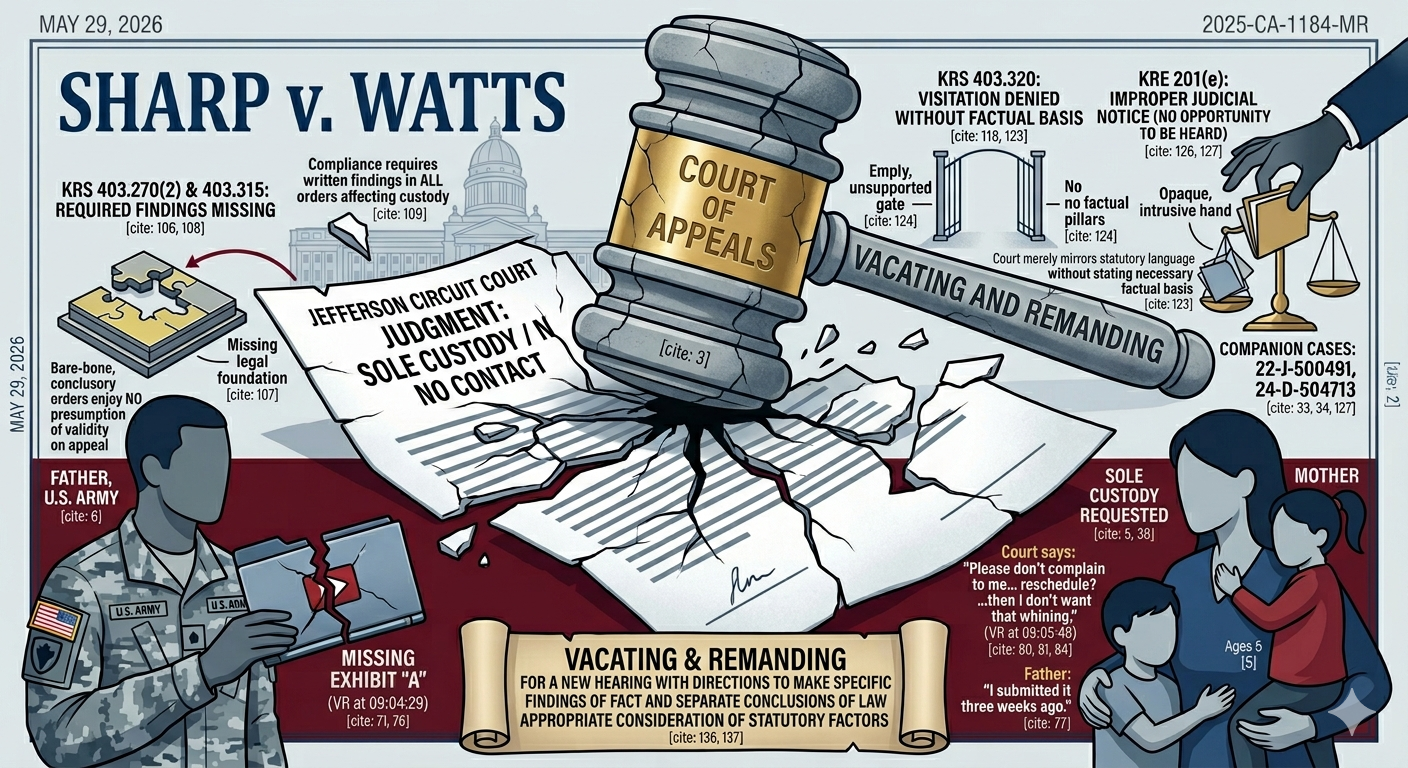
Quick read: On May 29, 2026, the Kentucky Court of Appeals vacated a Jefferson County Family Court order that awarded sole custody to one parent and denied the other parent all contact with his children. The Court found that the family court failed to make the specific findings of fact required by KRS 403.270(2) and KRS 403.320, and that it improperly took judicial notice of companion cases without giving the father notice or an opportunity to be heard. The case was remanded for a new hearing. Jason A. Bowman of Bowman Legal represented the father on appeal.
What Happened in This Case
Two unmarried parents were in a custody dispute over their two young children. The mother filed a petition for sole custody, citing concerns about domestic violence and the father’s behavior. A domestic violence order was already in place. The father, who is active duty military stationed in Kansas, responded and asked for joint custody or, at a minimum, a reasonable parenting schedule.
Both parents appeared at a hearing without attorneys. The family court awarded sole custody to the mother, gave the mother sole decision making authority over all issues involving the children, and ordered that the father have no contact with the children whatsoever. The father was also ordered to complete anger management and a full psychiatric evaluation before the court would even consider reinstating contact.
The father retained Jason A. Bowman of Bowman Legal to file an appeal to the Kentucky Court of Appeals, seeking a reversal of the trial court’s opinion.
What the Court of Appeals Found
The Court of Appeals reviewed the family court’s order and identified three significant legal errors that required the entire order to be vacated and the case sent back for a new hearing.
First: the family court failed to analyze the best interest factors. Under KRS 403.270(2), a Kentucky family court must determine custody based on the best interests of the child, and it must consider all of the relevant factors listed in the statute. These factors include each parent’s wishes, the child’s relationship with each parent, the child’s adjustment to home and school, the mental and physical health of all parties, and whether domestic violence has occurred. The Court of Appeals found that the family court’s order did not specifically mention or analyze any of these factors. It cited the correct statutes but never actually applied them to the facts. Citing the Kentucky Supreme Court’s decision in Keifer v. Keifer, 354 S.W.3d 123 (Ky. 2011), the Court of Appeals made clear that a conclusory order that sets forth nothing but the outcome is inadequate and will not survive appellate review.
Second: the family court denied all visitation without the required findings. Under KRS 403.320(1), a parent who is not granted custody is still entitled to reasonable visitation unless the court specifically finds that visitation would seriously endanger the child’s physical, mental, moral, or emotional health. The family court’s order used language that tracked the statute, stating that unrestricted visitation would seriously endanger the children. But it did not explain the factual basis for that conclusion. The Court of Appeals held that simply repeating the words of the statute is not enough. The court must state the specific facts that support the finding. Without that factual foundation, the order cannot stand.
Third: the family court improperly took judicial notice of companion cases. In its written order, the family court took judicial notice of findings from three companion cases, including dependency cases and the domestic violence action. The problem was that it did this on its own, without telling the father during the hearing that it planned to do so. The father did not learn about it until he received the written order. Under KRE 201(e), a party is entitled to be heard on the propriety of taking judicial notice and the substance of the matters being noticed. The father never had that opportunity, and the Court of Appeals agreed that this was error.
What This Means for Parents in Jefferson County Family Court
This case reinforces a principle that matters in every Kentucky custody or divorce dispute: a family court cannot simply announce a result. It must explain why it reached that result by making specific findings of fact tied to the statutory factors. When a court skips that step, the order is vulnerable on appeal.
For parents who feel they were not heard, who believe the court did not consider the evidence, or who received an order that does not explain the reasoning behind it, this opinion is a reminder that the appellate process exists to correct those errors.
It also serves as a warning to family courts. The Court of Appeals quoted the Kentucky Supreme Court’s language from Keifer emphasizing that family law orders are not just vehicles for appellate review. They serve as reference documents for parents, schools, medical providers, and government agencies. A bare bones order that says nothing about the facts does not serve anyone.
Why Appellate Experience Matters in Family Law
Most custody or divorce cases never go to the Court of Appeals. But when a trial court gets it wrong, having an attorney who understands the appellate process can make the difference between living with an unjust result and getting a second chance.
At Bowman Legal, family law appeals are a core part of what we do. Jason A. Bowman represented the father in this case, identified the legal errors in the family court’s order, briefed the issues to the Court of Appeals, and secured the vacatur of the order and a remand for a new hearing. The opposing party did not even file a brief in response.
Appellate work in family law requires a different skill set than trial work. It requires the ability to read a record carefully, identify where the trial court deviated from the law, and present those issues in a way that persuades an appellate panel. It also requires knowing which arguments have the strongest chance of success and which are better left aside. In this case, the Court of Appeals agreed with the father’s arguments on three separate grounds and vacated the order in its entirety.
Think the judge got it wrong?
Bowman Legal’s appellate division focuses exclusively on correcting trial court errors in family law and beyond. If a Kentucky court entered an order against you that ignored the evidence or skipped the required findings, our appeals team can review your case.
Frequently Asked Questions
Q: What does it mean when a custody order is vacated?
A: When a court of appeals vacates an order, it sets aside the order as though it was never entered. The case is then sent back (remanded) to the trial court for further proceedings. In this case, the Court of Appeals directed the family court to hold a new hearing and make specific findings of fact and conclusions of law.
Q: Does this mean the father automatically gets custody?
A: No. The Court of Appeals did not direct any particular result. It simply required the family court to follow the correct legal process. On remand, the family court will conduct a new hearing and apply the statutory best interest factors to determine custody and visitation.
Q: How do I know if my custody order has the required findings?
A: A proper Kentucky custody order should specifically address the factors listed in KRS 403.270(2), including the wishes of each parent, the child’s relationship with each parent, the child’s adjustment to home and community, and any findings regarding domestic violence. If your order simply states the outcome without explaining the court’s reasoning, it may be deficient.
Q: How long do I have to file an appeal of a custody order in Kentucky?
A: Under the Kentucky Rules of Appellate Procedure, a notice of appeal must generally be filed within 30 days of the entry of the final order. This deadline is strict. If you believe your custody order contains legal errors, contact an appellate attorney as soon as possible.
Contact Bowman Legal About Your Family Law Appeal
If you received a custody order in Kentucky that you believe is wrong, whether because the court did not consider the evidence, did not make the required findings, or did not follow the law, Bowman Legal can help. We handle family law appeals across Kentucky, including appeals from Jefferson County Family Court and courts throughout the Commonwealth. Learn more about our dedicated appellate practice at JudgeGotItWrong.com, or contact our office to discuss whether an appeal is the right path for your case.
Disclaimer: This blog post is for general informational purposes only and does not constitute legal advice. Every custody and family law case is different, and outcomes depend on specific facts and circumstances. Reading this post does not create an attorney client relationship. If you have a family law matter in Kentucky, you should consult with a licensed Kentucky attorney before making any legal decisions.